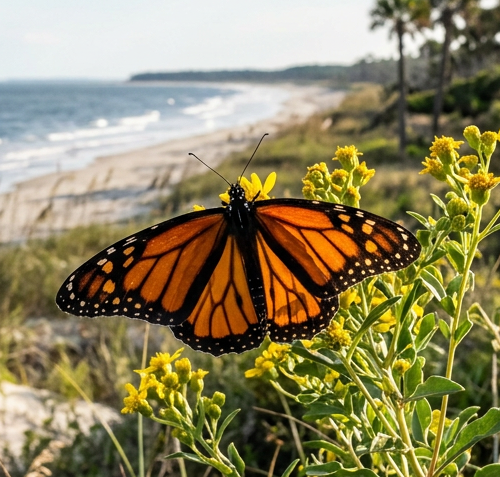
Did you know that not all monarch butterflies make the long journey to Mexico each fall?
Some appear to spend the entire year right here in coastal South Carolina!
For generations, we’ve marveled at the monarch’s extraordinary migration, with millions of butterflies traveling thousands of miles to overwinter in the mountains of central Mexico. But researchers have
uncovered a fascinating exception to this familiar story—one unfolding in the swamps, marshes, and barrier islands of South Carolina’s Low country.
The discovery began with retired South Carolina Department of Natural Resources biologist John “Billy” McCord, who started tagging monarchs in 1996. While studying butterflies along the coast,
McCord noticed something unexpected: monarchs were still present during November and December, when they were supposed to be in Mexico.
His observations eventually led to a five-year study with SCDNR scientist Dr. Michael Kendrick. Researchers tagged more than 18,000 monarchs and documented an unusual seasonal pattern. During
spring, summer, and fall, these butterflies were found throughout coastal plain swamps. In winter, they concentrated along the coastline and barrier islands, where cool, humid conditions offer a favorable
refuge.
Even more surprising was the discovery that these monarchs were found breeding in coastal habitats. Researchers observed mating activity and identified Gulf Coast swallowwort, a native relative of milkweed, as an additional host plant for monarch caterpillars. Along with aquatic milkweed found in inland swamps, this plant helps support the butterflies’ life cycle. These findings challenge long-held assumptions about monarch migration and suggest that South Carolina may support a distinct population segment of monarchs that remains in the region year-round. Scientists are continuing to study how these butterflies relate to the larger eastern monarch population.
For those of us dedicated to butterfly conservation, this discovery is an exciting reminder that important habitats may exist closer to home than we realize. Protecting native plants, wetlands, and coastal
ecosystems could play a meaningful role in preserving these remarkable butterflies. The next time you visit the South Carolina coast in winter, keep an eye out for a flash of orange and black. You just might spot a monarch that calls the Low country home all year long.
Sources & Further Reading
Garden & Gun, February/March 2024. Lindsey Liles, South Carolina Swamps
Harbor a Startling Secret About Monarch Butterflies.
Southern Living, October 2024. Article discussing monarch conservation and South Carolina’s nonmigratory monarch population.
South Carolina Department of Natural Resources, July 2023.
Unique Group of Monarch Butterflies Discovered in Coastal South Carolina.